How to Know If Someone Is Actually Your Customer (Before You Waste Time)
A practical way for solo founders to qualify leads fast—check Budget, Urgency, and Fit, evolve your Ideal Customer Profile, and decide who to reach out to in minutes (or let an AI copilot do it).
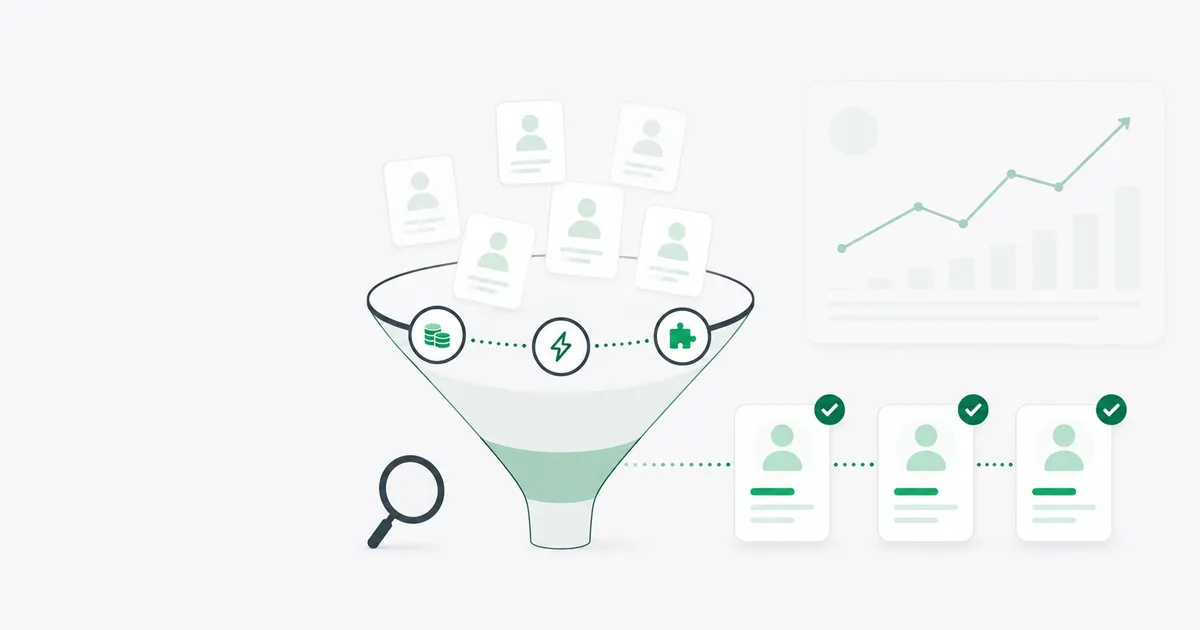
Not everyone with the problem is your customer.
You can spend an hour researching and drafting the perfect message to someone who will never buy.
Here’s how to filter before you invest the time.
The Cost of Bad Targeting
Every solo founder hits the same wall: you’re doing outreach, but most of it goes nowhere. The hidden tax isn’t just the non-replies—it’s the compounding time and focus you lose.
- 15 minutes researching someone who can’t afford you
- 3 follow-ups to someone who was never going to convert
- Mental energy on conversations that go nowhere
Multiply that by 20 prospects/month and you’ve wasted 5+ hours you could have put into people who actually convert. That’s a full deep-work block you never get back—time that should be spent on warm, high-fit leads. The fix: filter first. If you’re wondering how to qualify leads quickly and decide who to reach out to, start by checking three signals before you write a single line.
The 3 Signals That Matter
Signal 1: Budget
Can they afford what you’re selling?
Look for:
- Evidence they already pay for tools/services in your category
- Company size/revenue that suggests a realistic budget
- Language about ROI and outcomes, not just “what’s the cheapest/free”
Red flags:
- Every post compares free alternatives
- “Just launched” with no revenue yet (unless you sell to pre-revenue)
- Price-shopping across 10+ options with no decision criteria
Signal 2: Urgency
Are they trying to solve this now, or just casually interested?
Look for:
- Recent posts (last 48h) about the problem or a related blocker
- Words like “struggling,” “need to fix,” “losing time/money”
- Asking for recommendations, timelines, or implementation help
Red flags:
- They mentioned it 6 months ago and haven’t revisited it
- Vague interest: “would be nice to have”
- Not taking any visible action (no trials, no questions, no deadlines)
Signal 3: Fit
Does your solution actually solve their specific problem?
Look for:
- Their use case matches what you built for
- Their context aligns (solo, small team, specific industry)
- The pain they describe is exactly what you solve
Red flags:
- They need enterprise features or compliance you don’t have
- Their problem is adjacent, not core to your product’s value
- They’re in a vertical you’ve never served and would be a risky stretch
How to Filter Fast
You don’t need a 20-field scorecard. You need a 3-minute pass that answers Budget, Urgency, and Fit with confidence.
Manual process (3–5 min/person):
- Open their profile.
- Scan the last 5–10 posts for signals (budget, urgency, fit).
- Check their website or product footprint for pricing/revenue clues.
- Yes to all three? Add to your outreach list.
No to any? Skip.
If you’re evaluating 20 prospects, that’s 60–100 minutes just to filter. Still worth it—but there’s a faster path.
With AI (10–15 min for 20 people):
- You land on a profile.
- An AI copilot reads recent activity and surfaces:
- Budget: yes/no (with evidence)
- Urgency: high/medium/low (with quotes/snippets)
- Fit: % match to your Ideal Customer Profile (ICP)
- You decide in ~30 seconds: reach out or skip.
Same filtering logic, far less time. This is how to qualify leads at scale without turning your outreach into spam.
Build Your ICP Over Time
Your Ideal Customer Profile isn’t static—especially as a solo founder. Treat it as a living model that improves with every conversation.
Start with assumptions:
- Who you think will buy (role, industry, team size)
- What signals should predict conversion (budget, urgency, fit cues)
- Core problems you solve and which use cases are best
Refine with data (30–60 days):
- Track who replies and who converts
- Note patterns: industry, company size, phrases they use, problems they mention
- Update your disqualifiers (e.g., “needs SSO/enterprise security” if you don’t support it yet)
- Tighten your “who to reach out to” rules and your “skip” criteria
What you’ll know after a few cycles:
- Which signals truly predict replies and revenue
- What your real ICP looks like (not just what you imagined)
- Where to focus your time next month
An AI copilot can learn this with you: it tags the prospects you select, observes which ones convert, and continuously adjusts the match score and the evidence it highlights.
Putting It All Together
Outreach isn’t about volume. It’s about talking to the right people. Filter first, then personalize.
- Before writing, confirm Budget, Urgency, and Fit.
- Personalize with 1–2 specifics from their recent activity.
- Make a low-friction ask (e.g., “Worth a 10‑min call to see if X solves Y?”).
- Log the outcome so your ICP and filters keep improving.
You can do this manually—profile by profile, tracking in a spreadsheet. Or you can let an AI copilot handle the filtering and learn what “right fit” means for your business over time. Both work. One just doesn’t take an hour to evaluate 20 people.