What is Vibe Coding (And Why It's Killing Your Business)
Vibe coding is building apps because they're interesting, not because customers asked. Here's why it kills businesses—and what to do instead.
Intro
You spent two weeks building that feature. The code is clean. The UI is smooth. You launch on Twitter or Product Hunt or wherever.
Crickets.
Not because your app is bad. Because you built something nobody asked for.
Vibe coding is when you build an app because the problem seems interesting. Because you want to try that new framework. Because it feels like a cool idea. Not because someone told you “I need this and I’ll pay for it.”
Here’s why that mindset quietly suffocates your business—and what successful solo founders do instead.
“Vibe coding is fun. Vibe selling is uncomfortable. Only one pays your bills.”
The problem with vibe coding
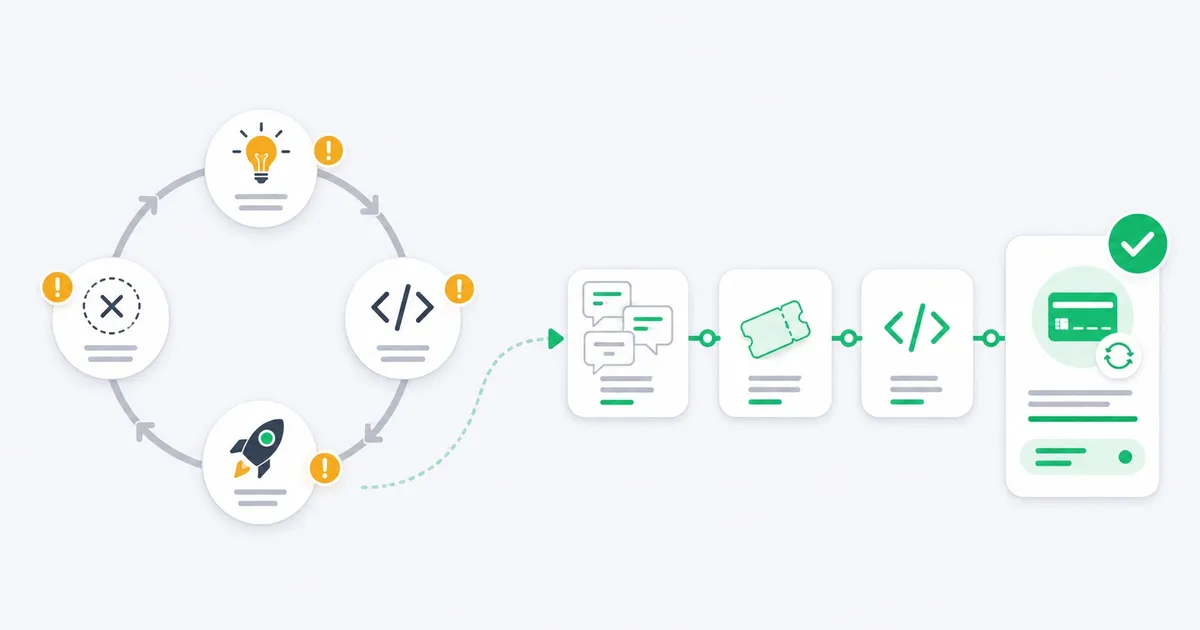
The vibe coding loop (and why it never ends)
- Idea phase
- “This problem seems interesting.”
- “I could build this in a weekend.”
- “I’ll use that shiny new tech to try it out.”
- Build phase
- You ship fast (days, then weeks).
- The code works.
- You feel productive.
- Launch phase
- You post on social and get a handful of likes.
- A few “nice!” comments trickle in.
- But nobody pulls out a card.
- The reckoning
- “Maybe I need more features?”
- “Maybe I need better marketing?”
- “Maybe I should post more?”
- The uncomfortable truth: nobody asked you to build this.
Why this loop hurts
- ❌ It’s not the code. It runs.
- ❌ It’s not the design. It’s clean.
- ❌ It’s not even “marketing.” It’s demand. You built in a vacuum.
The loop persists because the “solution” you reach for is always more building. Another setting. Another integration. More polish. Anything except talking to people who actually feel the pain you’re guessing about. The longer you stay in the loop, the more sunk cost you create—and the harder it feels to stop.
What vibe coding optimizes for
- Interesting problems instead of urgent pains.
- Elegance instead of outcomes.
- Launches instead of learning.
What a business needs
- A specific person with a specific pain that’s happening right now.
- A simple way to reduce that pain.
- A clear path to money.
“Vibe coding optimizes for ‘interesting to build.’ Vibe selling optimizes for ‘someone will pay for this.’”
The moment you switch your metric from “did I ship?” to “did someone ask for this before I wrote code?” your roadmap changes. You say no to entire projects. You say yes to tiny, boring features that people actually want. You stop burning months on things that only feel productive.
Why we keep doing it (even though it doesn’t work)
Building feels productive. Selling feels scary.
- Shipping code is visible progress you control. You can sit down, enter flow, and end with a PR.
- Reaching out is visible risk you can’t control. They might ignore you. That stings.
“If you build it, they will come” is a lie we love.
- It shows up as magical thinking: “This is so cool—surely someone needs it.”
- It lets you delay the uncomfortable part (asking, listening, being told “not for me”).
The dopamine hit of creation.
- New repos. New components. New animations. Creation gives instant rewards.
- Even “launching” gives a hit, regardless of whether anyone uses it.
You’re good at building, not (yet) at finding demand.
- You’ve learned to solve technical problems.
- Nobody taught you how to find people who actually have the problem today.
There’s no shame in any of this. It’s normal. But if you need revenue, you have to swap vibes for validation.
“You don’t have a marketing problem. You have a guessing problem.”
So what’s the alternative?
The alternative: vibe selling
Find customers first, build second
Instead of starting with code, start with people.
| Vibe coding | Vibe selling |
|---|---|
| Idea → Build → Launch → Hope to find people | Idea → Find people → Pre‑sell → Build |
| “I hope someone needs this.” | “People already asked. Now I’ll build.” |
| 0 revenue, 0 validation | Commitments or revenue before code |
How vibe selling works (in practice)
Step 1: Define the pain
- Not “an app for X.”
- Yes “people complaining about Y” in places you can read: Reddit threads, Twitter/X posts, LinkedIn updates, community forums.
- Write the pain in their words, not yours.
Step 2: Find 20 people with that pain
- Where they’ve already said it out loud in the last few days or weeks.
- Save links to their posts or profiles. Capture the exact line that shows the pain.
Step 3: Contact them (before you build anything)
- Send a short, human DM that references what they said and asks if a tiny helper would be useful.
- If most people say “not really,” that’s data you got in hours, not months.
- If enough people say “yes, please,” you have a green light to build the smallest thing that helps.
Step 4: Pre‑sell (optional, powerful)
- Offer early access at a simple price.
- If nobody’s willing to pay yet, learn more: maybe the pain is real but your proposed fix isn’t.
- If a few people pay, that’s strong validation and early runway.
Why this works
- ✅ You build with real feedback from the start.
- ✅ You hear the language your audience uses (so your messages land).
- ✅ You cut entire features because nobody asked for them.
- ✅ You’re no longer guessing—you’re responding.
“The only MVP that matters is the Minimum Validated Problem.”
This doesn’t make things easy. It makes them clear. You trade limitless possibilities for a specific person, a specific problem, and a specific promise. That’s what turns projects into products.
Real example: from vibe coding to first customer
Before (vibe coding)
- “Built a project management tool for remote teams.”
- Spent months adding boards, automations, and integrations.
- Six months after launch: still zero paying users.
After (vibe selling)
- Joined several remote‑work communities and searched for a single repeated complaint: “handoffs keep slipping—updates are too long to read.”
- Found dozens of fresh posts/comments that matched that pain.
- Sent short DMs referencing the exact phrasing and offering a tiny helper (“one‑screen weekly update format”).
- A handful said “yes” and pre‑bought early access. Built the smallest version in two weeks.
- Kept scope narrow: a dead‑simple template and a tiny tool that enforced the format people liked.
- Ended the month with a small set of paying users who had already asked for it—then grew from there.
The difference wasn’t better code. It was starting with demand, not with vibes.
Make the shift: start with demand
If you want revenue, start with demand:
- Find people who already say the problem out loud.
- Ask if a tiny helper would be useful—before you write code.
- Pre‑sell if you can. Then build the smallest thing that delivers the promise.
The hard part is the manual work. You’d have to:
- Search Reddit, Twitter/X, and LinkedIn daily.
- Read a pile of posts to spot real pain.
- Track who’s talking about what.
- Craft short, context‑aware DMs without sounding templated.
That’s where tooling helps—without turning you into “sales.” FirstSell works across social networks, finds people actively talking about the pain you solve, highlights exactly what to reference, and drafts short, human DMs in your tone. You review and send. No scripts. No spam. Just clear, personal messages to people who already care.
Want to go deeper?
- Compare approaches: Vibe coding vs vibe selling → /blog/vibe-coding-vs-vibe-selling
- Shift step‑by‑step: How to move from vibe coding to vibe selling → /blog/how-to-shift-to-vibe-selling
- Start from demand: Vibe selling page → /vibe-selling
“Stop guessing if anyone needs what you’re building. Let people’s words pull you to the product.”
FAQ
-
Is all vibe coding bad?
- No. If you’re learning or deliberately exploring, build for vibes. If you need revenue, flip the order: people first, code second.
-
Can I “vibe sell” an existing product I already built?
- Yes. Start with one pain your current app can solve. Find 20 people who say that pain out loud, reach out with a tiny helper, and validate interest before adding new features.
-
What if nobody wants what I built?
- Then you just saved months by admitting it early. Pivot to the language people already use for a real pain—or kill it and free yourself to build what’s actually needed.
Other Links
- Post 2: Vibe Coding vs Vibe Selling: Which One Pays Your Rent?
- Post 3: How to Shift from Vibe Coding to Vibe Selling (Step-by-Step)
- Landing: Vibe selling