How to Shift from Vibe Coding to Vibe Selling (Step-by-Step)
You already built. AI finds prospects and drafts messages from real conversations. You review, refine, and send. Stop manual prospecting—start vibe selling.
How to Shift from Vibe Coding to Vibe Selling (Step-by-Step)
You built something. Nobody’s using it. The default reaction is manual prospecting: spend hours searching Reddit and Twitter, skim endless threads, draft one-off messages, and update a spreadsheet. That’s the sales equivalent of writing code without an AI assistant—painfully slow, inconsistent, and hard to sustain. There’s a better way. The vibe selling workflow treats selling like vibe coding: AI handles the repetitive work, you apply judgment and ship. In practice, that means AI prospecting to automate customer search, plus an AI sales assistant that drafts tailored messages from what people actually said. You review, refine, send. Here’s how to make the shift.
The vibe selling workflow
Vibe coding:
- You describe what you want
- AI generates code
- You review, refine, ship
Vibe selling:
- You define your ICP
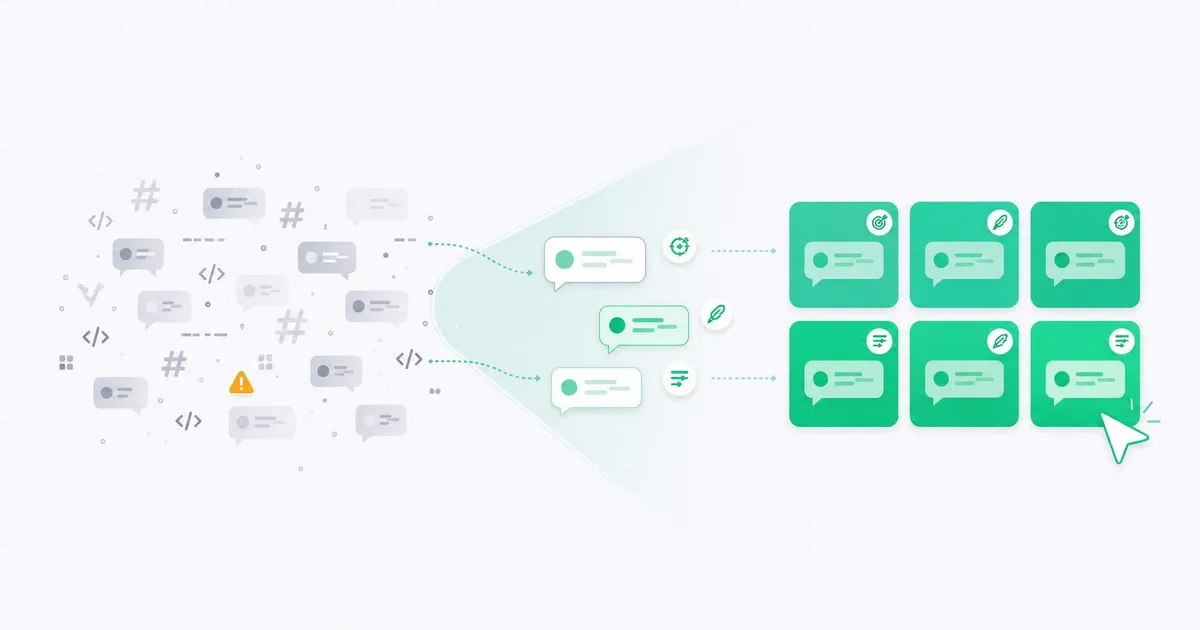
- AI finds people with that pain
- AI drafts personalized messages
- You review, refine, send
The parallel is the point. AI handles the grunt work—searching, filtering, drafting. You make the judgment calls—fit, tone, timing. You keep control, but you stop burning time on tasks a machine can do 24/7. This is an AI-first, not manual, workflow.
Step 1: Define your ICP (the only manual part)
AI can’t guess who you serve. Spend 10 focused minutes to define:
- Who has the problem (role/persona)
- The core pain point (what they actually complain about)
- Where they talk about it (Reddit, Twitter, LinkedIn, forums)
- Deal-breakers (who you don’t want)
Write it as a single line you can paste into your system: “I’m looking for [role] who complain about [pain] on [platform].” Add useful filters: team size, tech stack, buying signals (mentions of “paid,” “upgrade,” “switching”), and hard exclusions (agencies, students, hobbyists). If you know three exact phrases they use when stuck, list those too. This sharpens the net. Define once; iterate later based on data.
Step 2: Let AI find prospects (you don’t)
Your AI sales assistant monitors platforms where your ICP vents and asks. It’s AI prospecting built for signal, not noise. It:
- Watches relevant subreddits, hashtags, and groups for pain-keywords
- Filters out bots, promos, and low-intent posts
- Captures the profile and the precise context (what they said, when, where)
- Scores intent by language cues, recency, and engagement
- Delivers a short, qualified list each week
Your job is light-touch review:
- Skim the queue
- Remove edge cases
- Approve who to contact
Time cost: about 15 minutes per week versus 10 hours of manual grind. You’re not doom-scrolling; you’re triaging a curated list. The system doesn’t sleep, doesn’t miss threads, and doesn’t get bored.
Manual prospecting vs vibe selling (AI-assisted)
| Category | Manual prospecting | Vibe selling (AI-assisted) |
|---|---|---|
| Time | ~10 hours/week searching and drafting | ~15 minutes/week reviewing and approving |
| Coverage | Sporadic; you miss threads when offline | 24/7 monitoring with real-time capture |
| Consistency | Burnout after two weeks | Sustainable, repeatable cadence |
| Personalization | From scratch every time | Drafts personalized from what they said |
| Learning | Ad hoc, in your head | Centralized tracking and feedback loops |
“You don’t write code line-by-line. Don’t search for customers that way either.”
Step 3: Let AI draft messages (you refine)
The AI reads what the prospect actually said and proposes a short, context-aware outreach. It references the pain in their own words and stays conversational, not salesy. Your inputs are minimal but decisive:
- Check fit and tone
- Make small edits to align with your voice
- Add a helpful nugget if you have one
- Approve or reject
It’s the same workflow as editing AI-generated code. You’re applying judgment to a solid first draft, not starting from a blank page. Expect about two minutes per message rather than ten. Multiply that time delta by 20–30 approved prospects a week and you’ve reclaimed hours—without sacrificing relevance. No templates blasted at scale, no gimmicks. Just targeted, context-driven outreach that sounds like a human who paid attention.
Step 4: Send, track, iterate
Once messages go out, the AI assistant handles the bookkeeping:
- Logs contacts, replies, and interest level
- Tags which angles get responses
- Surfaces platform/keyword combos with higher intent
Your job is to run small experiments and keep the loop tight:
- If response rates are low, refine the ICP (role, pain, platform)
- If interest is high but meetings don’t happen, adjust your angle or next step
- Double down on channels and phrases that convert
Treat this exactly like development: short sprints, quick feedback, ship the winner. The vibe selling workflow compounds because every week, the system gets better at filtering and drafting for your niche.
Why this isn’t spam
Mass-outreach tools blast 500 generic messages and celebrate a 0.5% response rate. That’s noise, not selling. Vibe selling prioritizes quality over volume: 20 personalized messages per week that reference what the person actually said routinely earn 20–30% response rates. The difference is relevance and consent. You’re entering a live conversation with useful context, offering help before asking for anything, and making it easy to opt out. That’s how you avoid the spam bucket while still scaling with AI.
Make the shift
If you already trust AI to write boilerplate code, there’s no reason to do customer search by hand. Adopt an AI-first selling loop:
- Define your ICP once with clear pains, places, and exclusions.
- Let AI monitor conversations and deliver qualified prospects.
- Let AI draft first-pass messages from the prospect’s own words.
- You review, refine, send—and then iterate based on tracked results.
The outcome is a calmer pipeline: fewer tasks that drain you, more signals you can act on, and a workflow that scales with your available time. Selling becomes a daily habit, not a weekend chore.
For background on the mindset, read What is Vibe Coding (/blog/en/what-is-vibe-coding). For a high-level comparison of build-first vs sell-first, see Vibe Coding vs Vibe Selling (/blog/en/vibe-coding-vs-vibe-selling).
When you’re ready to stop grinding and start compounding, let the system do the heavy lifting. You define intent; the assistant automates customer search, drafts outreach, and tracks what works. You keep the judgment and the human touch.
Other links
- Post 1: What is Vibe Coding (And Why It’s Killing Your Business)
- Post 2: Vibe Coding vs Vibe Selling: Which One Pays Your Rent?
- Landing: Vibe selling